Sunday, 30 September 2018

Autumn vegetables

Autumn has come to the garden. I got back from holiday to a garden that was in decline.

In the sunshine it still has a certain something, especially as the cosmos plants have finally flowered (late as ever in my garden), but in the chill of early morning it looks rather bleaker.
The corn is now brown and old. My courgettes have produced one last, huge courgette, but stopped flowering, so there will be no more there. The cucurbits (squashes and courgettes) are also uniformly covered in a dusting of powdery mildew and many patches are bare where I removed leaves to try and prevent the mildew from spreading. Interestingly, the only places the cucurbits aren't consumed in mildew are where the plants have crept into and up my bean stalks. I'm not sure if there's something protective about the beans or if it's being off the ground they like. I will try to remember to give them supports next year so they can lift themselves off the ground.
My purple beans  also fell over in the winds of the storms while we were away, and my sunflowers lost a number of stalks and seed heads to the storms.
However, all was not lost. Despite having toppled to the side, the purple bean plants are still producing plenty of beans. My squashes are finally turning from deep green to ripe orange.
It is the season for harvesting, so there is plenty to eat in the garden yet. Last night, having finally finished off the latest crop of beans I was wondering what except chard (which I like much more to look at than to eat), I could possibly eat with my dinner. It was then that I had an aha moment. All those things I'd been ignoring all summer because they were too small were finally ready to harvest. So I pulled out two beetroot and two carrots.
I've been growing multi-coloured carrots this year, but it so happens that the two I pulled out were both a pale yellow. They tasted every bit as carroty as orange carrots, especially as I cooked them the way that retains flavour the best: remove the stalks and peel, but otherwise leave whole. Boil for 15 minutes, then chop once cooked.
I peeled and quartered the beetroots and roasted them along with my potatoes. Finally, I selected the smaller, fresher beetroot leaves and cooked them just like I cook chard. I cut out the stalks and chopped them into 3 cm lengths, then roughly chopped the remaining leaves. The stalks I boiled for 6 minutes (in with the carrots for the last 6 minutes of their cooking time) and the chopped beetroot leaves I boiled for 3 minutes (also in with the carrots). They turned the water a bit red, but seem not to have had any impact on the colour of the carrots themselves. In case you're wondering, the meat is roast gammon and I made a cider gravy to go with it.

Cider gravy recipe (serves 4 with a thick gravy, 6 or 8 with a thinner gravy):

1 tbsp butter
1 tbsp cornflour (=cornstarch in US English)
1 small bottle of (optionally low/no alcohol) cider
Optionally some of the juice that has collected in the pan from any meat you are roasting

1. Melt the butter in a pan over a low heat.
2. Add the cornflour and stir to form a paste.
3. Gradually add the cider about 1-2 tbsp at a time. Keep stirring until the gravy is smooth each time before you add any more. Keep adding cider until you have a consistency you like. Once you have reached a consistency you like, turn up the heat and keep stirring until the gravy bubbles. Once it has bubbled, check whether you still like the consistency. If it's too thick now, add more cider as before.
4. Optionally add 1-2 tbsp of the juices from any meat you were roasting and stir in.

Sunday, 2 September 2018

Grass doesn't need watering in the UK

Grass is a survivor. We had the longest rain-free heatwave I can remember in my life this summer. The grass became brown in patches and dry all over. It looked like it was a goner. But I didn't water, because I know grass is a survivor. And because water was scarce in the heatwave and I didn't want to waste it on grass when we had so little to go round. The rain started again in early August. And my lawn sprang back to life. It's now September and my lawn is almost entirely healthy green again.
After the rain
Before the rain
My beetroots and my chard also loved all this rain and the extra growing time. 


My cucurbits weren't so keen. Every time it rained, powdery mildew afflicted some of the leaves. It started with just a few spots.
These were often just on the back of the leaf, so unless you know to look from the mild discolouration on the front you didn't notice unless you turned it over.
Eventually it spreads to the whole leaf.
My initial policy was to remove all these leaves and destroy them (they can't go on the compost heap, as the powdery mildew would stay in the compost).
But more and more leaves were becoming afflicted. Every time it rained leaf after leaf would be affected, especially the older leaves. Getting rid of the leaves was becoming a nuisance and the plants were putting all their energy into regrowing the leaves and hardly any into making new courgettes. All except one, it turned out, which was hidden under the sage until my other half protested its messiness and chopped it back.
It's a bit big to be eaten in most courgette recipes, but will make a lovely soup.
So I've now got to the time of year when I'm not fighting it any more. I'm not chopping off any more leaves with mildew and am letting my courgette beds recover from the devastation I caused to the courgette beds with all my cutting, albeit with a dusting of powdery mildew over the top.
I fight this battle every year, each year knowing that there will come a point when I give up and let it go. Cucurbits are strange plants. They need a huge amount of water, but if they get it from rain, then they tend to succumb to powdery mildew. Only in environments carefully crafted by people, with water from a watering can instead of the sky, are they happy.

Saturday, 4 August 2018

Fruit is ripening in the garden

Fruit is ripening in the garden. Despite it only being early August, the apples on my dwarf Katya apple tree are ripe enough to eat already.
I know, because one fell off and I tried it. I'm not going to pick any more just yet though, as I think the fruit could have been both sweeter and larger, so I'm hoping that's what will happen to them over the course of this month.
I had my first raspberries this week too, as an accompaniment to some American pancakes with yogurt.
I've also been producing a lot of courgettes. This one reached the size of a marrow before I had time to use it.
They creep up on you so quickly. One day you think you haven't got any courgettes and the next day you notice that there had been one hiding there the whole time and it's now huge. The courgettes are now a lot easier to find, though. The rain brought a lot of powdery mildew with it, so I had to remove a lot of the courgette leaves to get rid of it. If you leave any leaves with even tiny spots of it, it spreads until the whole lot is covered. The courgette patch is now looking pretty bare, but the individual courgettes are easier to pick out. Interestingly, so far this year powdery mildew has mainly affected the courgettes and barely touched the squashes.
My banana peppers have also ripened, but were a bit of a disappointment. Even ripe it tasted like a boring, shop-bought green pepper. I'm hoping it has some further ripening to go.

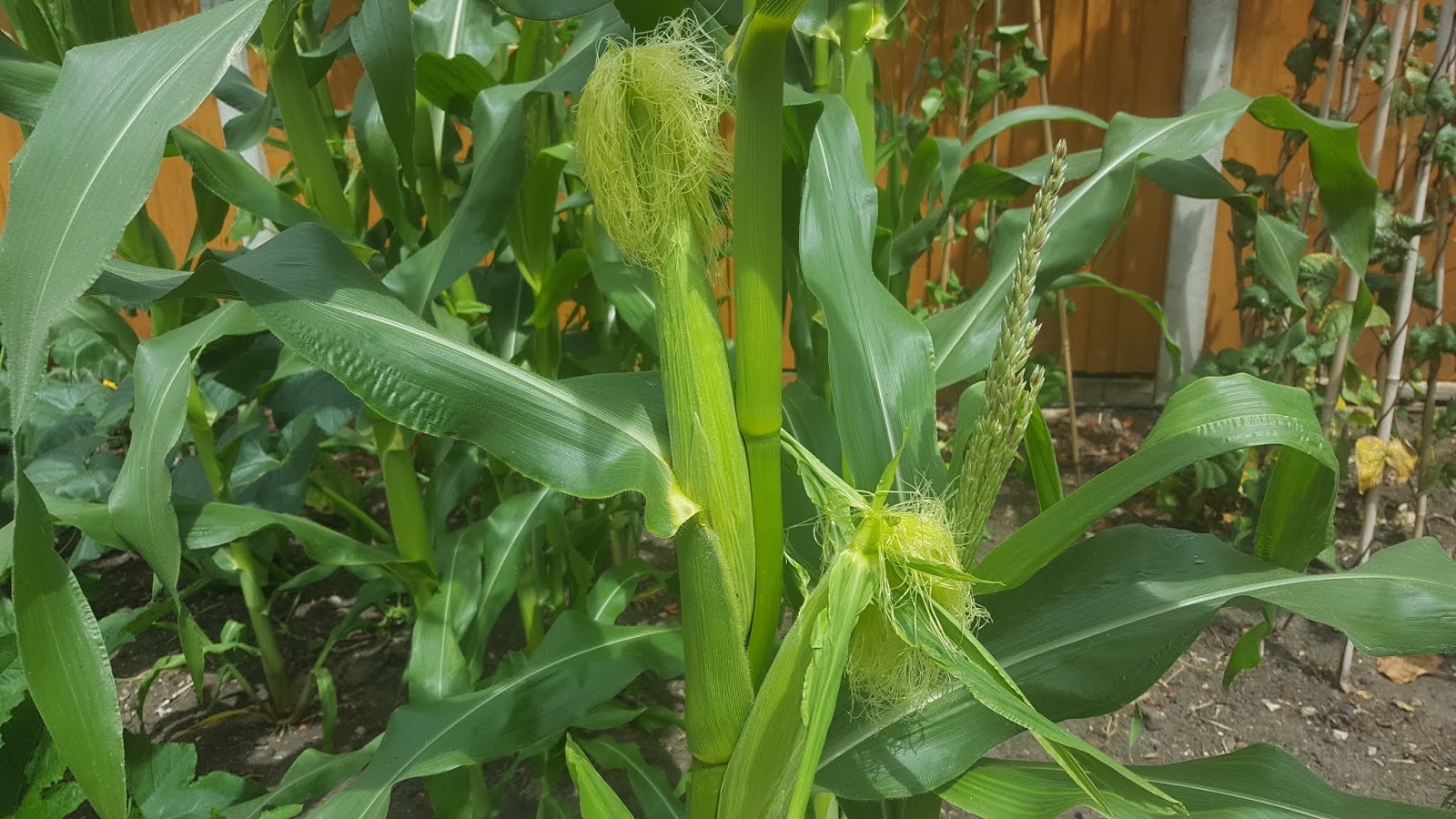
I can also report that my sweet corn is not quite ripe yet, the hairs (the silk) at the top probably need to go browner than that. According to this website, I should have been paying more attention to when the silk first appeared, as corn is usually ready 20 days after that. I need to puncture a kernel of corn and look for a milky liquid inside. Clear liquid means I'm too early and no liquid means I'm too late. I guess that means we need to eat the corn soon. Especially as it definitely tastes better when I eat it too soon than too late.
And finally, here's a picture of a bee enjoying one of my sunflowers, just because bees and sunflowers make me happy.


Saturday, 28 July 2018

After the rain

The dry heatwave finally broke yesterday afternoon with a thunderstorm and tumultuous rain. The dustiness has gone. The garden feels fresh. Moisture is still in the air, making it cooler. The earth is damp and the lawn has already started to green back up. The smell of the rain itself has gone, but there is a smell of freshness and vegetation hanging in the air.
After the rain - 28 July
Before the rain - 27 July
Funnily enough, the storm did not completely refill my pond, but it did fill up a fair amount of my two water butts, so I have topped the pond up with my watering can using the rainwater. The pond smells badly of sulphur when disturbed, so something is probably rotting in it. I need to clear it out when I get time.
The reason I was out taking photos yesterday is that my sunflowers have finally flowered! They're facing the wrong way from my perspective, as they face away from the house, but they're still lovely.
They're much shorter than last year because I planted them late and left them in pots for longer than I should have. But actually they're already a good height - well over 5 foot - and I expect them to continue to produce more flowers and grow in height for a while yet, so their relative shortness right now is no bad thing.

Sunday, 22 July 2018

Garden beating expectations

Apart from my carrots, which we won't dwell on, the garden is massively exceeding the expectations I had of it at the beginning of the season. Because I started late and then had to restart several squash plants after slug damage, I was worried that I might have a poor season and not get a decent harvest. Well, my garden has set out to prove me wrong. With my regular watering and all this hot weather and sunshine, almost everything is flourishing.
I've harvested around half my onions, so that I could use the space for more beetroot. They've come out a decent size this year and none of them went to seed.
I've also got at least one squash that looks like it's going to be a decent size.
My raspberries have grown really well, considering how little I've watered them. I've had a few ripen already.
More of my kohl rabi is ready to eat - I need to remember to have salad next week, possibly with raw courgette in it. I'm producing so many of them.
The lettuce I grew in pots is working out far better than when I grow it in the ground - far less slug damage.
My sweet corn has grown cobs already, though they're not ready to harvest yet.
My beans have grown flowers, even though I planted them so late.

And I have my first pepper growing in the greenhouse. It is a banana pepper and will go yellow when it's ripe.
Overall, I'm very pleased with my progress.

Courgette, potato and Parmesan soup

I made this soup based on ingredients I had in the garden and in the fridge. It turned out nice, so here's the recipe:

800 g potatoes
1 kg courgettes (big ones are fine)
2 medium carrots
2 vegetable stock cubes
6 tbsp grated Parmesan
1/4 tsp nutmeg
salt and pepper

1. Boil a kettle of water.

2. Optionally peel the potatoes. Roughly chop them and put them into a large pan with just enough boiling water to cover them. Crumble in the stock cubes. Bring back to the boil, then cover and cook for 5 minutes.

3. While the potatoes are cooking, peel and chop the carrots and chop the courgettes into chunks. After the 5 minutes is up, add the carrots and courgettes, put the lid back on and cook for 10 more minutes.

4. Take off the heat, then stir in the Parmesan and season with the nutmeg, salt and pepper. When it has cooled enough not to damage your liquidiser, liquidise it to a thick soup. Optionally add more boiling water if you would like a less thick consistency.

Sunday, 8 July 2018

Heatwave dries out the garden, solar panels installed

London has been in a heatwave with no rain for several weeks now. I've been watering the vegetables, because they won't survive without watering, but I've left everything else. As a result, I now have huge vegetable plants and yellowing grass. But that's OK, grass is hardy, it can survive any weather Britain throws at it. It'll green up again as soon as we get some rain.

The pond is also suffering badly. Several inches of water have evaporated.
I have no rainwater left in my water butts, so I am currently letting water sit for 24 hours in the watering can to replenish the pond, as no rain is expected.
In a move to harness all this sun, we have a new addition to the shed. My husband has added solar panels. He designed and built the stand they are on so that they take maximum advantage of the sun. It has three positions: the middle one (in the picture) is angled to capture maximum summer sun, there's an even steeper angle for winter sun and flat against the shed roof so they can weather storms without getting blown away.

He also built us a log store. I've got to say, I'm really impressed with all his woodwork, especially as he works in a completely unrelated field. The log store in particular looks very smart.