Saturday, 25 May 2019

May, the month of making up for lost plants


As ever, I've had quite a few things go wrong in the garden in May. Slugs have devastated my brassicas.
Slug rings have proved very effective, as you can see from the picture above, where all the turnips in the ring have survived and all the ones outside it, including quite large ones I transplanted from inside the ring, have been eaten away to nothing. Fortunately this doesn't seem to apply to rocket (on the left), but it does apply to kale, broccoli and, to a lesser extent, to kohlrabi. I know this because I then tried planting the same kale seeds that appeared not to have germinated in my beds in normal soil in pots:
They germinated fine, so I can only conclude slugs and snails ate them before I even got a chance to see them. I've tried leaving a pot of water in which I've boiled garlic out and I've tried spraying garlic, but neither has worked, possibly partly because my regular watering just washed the garlic spray back off the plants again.
I now have a choice between:

  1. giving up on growing brassicas other than rocket and the hardier of my kohlrabi this year, 
  2. ordering enough slug rings for every plant (I am actually considering this), 
  3. using slug pellets, or 
  4. destroying the sage, marjoram and oregano patch where the slugs and snails live. Destruction of places where snails shelter has been very effective elsewhere in the garden. 

I really don't want to use slug pellets - I've managed entirely without so far this year, having instead crushed all snails I find beneath my shoes. But unfortunately the sage is beloved by bees, which means removing it will impact them.

On the other hand, I've already planted sage in my front garden. Also, bees and I generally have pretty similar flower preferences, so there are generally bees everywhere in my garden for most of the year. Moreover, bees do also enjoy my vegetable flowers, such as my broad beans:


So, my current decision is that I am going to wait until the sage has finished flowering and then pull out all of it that's in the back garden. That way bees get the benefit this year. I'll leave my brassicas in pots until then.
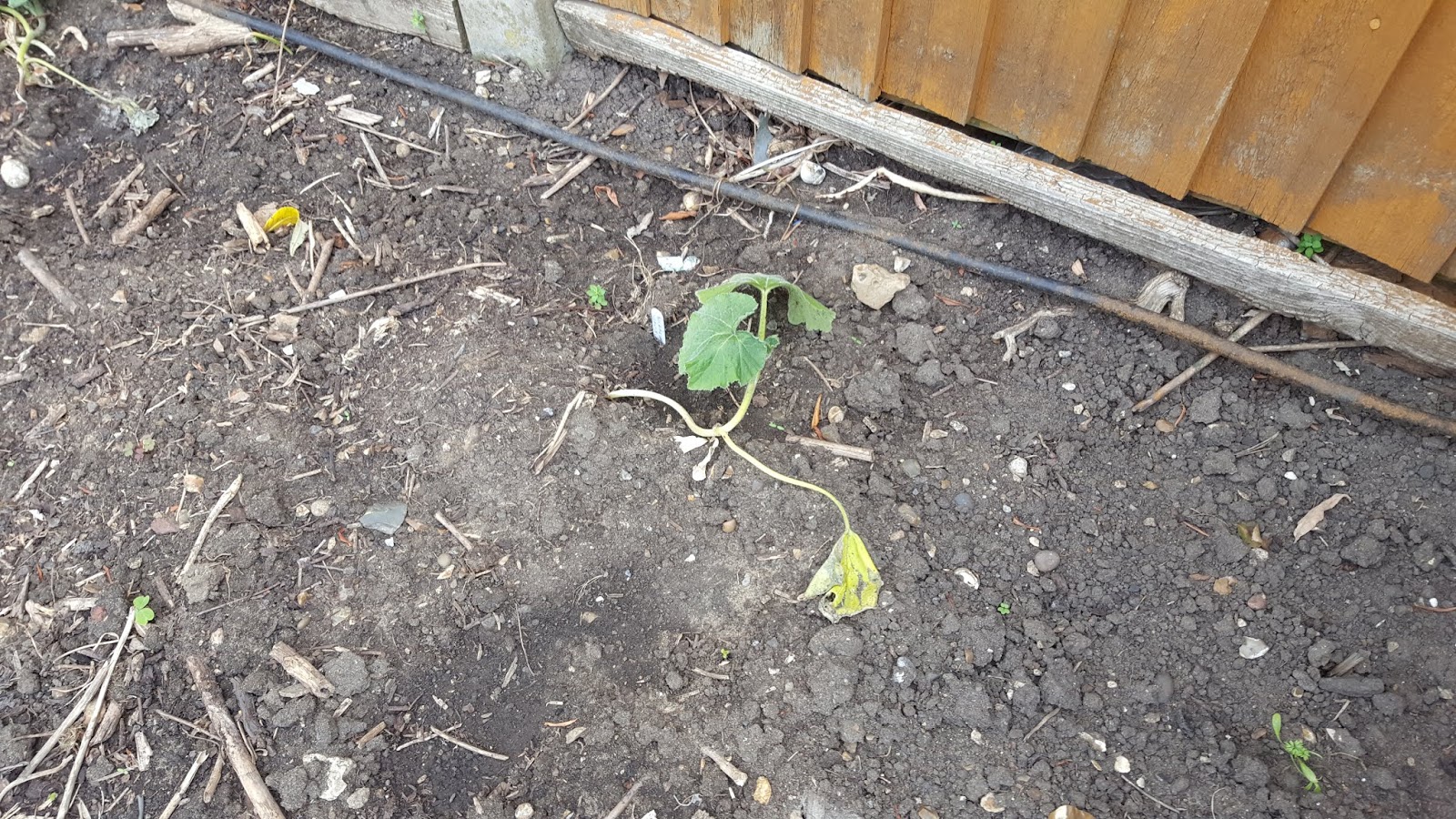
Elsewhere in the garden I have been devastated once again by my own incompetence with cucurbits (in this case squash and courgettes). It was all going so swimmingly. I waited till April to start them indoors in pots so they didn't get too big and delicate before I planted them out, as I have a tendency to damage the stems when that happens. They were growing great guns. Then, I took them outside to harden off. I made the mistake of putting them in far too sunny a spot and far too close together. Instantly leaves started withering from all the sunshine and its rapid drying effect on the soil in their pots. Then, when I came to plant them out, I discovered I had put them far too close together and their leaves and stems had become tangled. Lifting them up broke several of the stems, so when I put them in the ground, most of them upped and died on me. This scraggy looking specimen is one of the hardier and larger survivors. So here I am, back at square one, just like last year when slugs ate all the squashes I planted out.
So, as I was out of courgette seeds due to the infestation of my cucurbit seed envelopes, I nipped down to the local garden centre and bought some new yellow courgette seeds (in line with my unusual colours policy for this year). I then planted these and some winter squash sweet dumpling seeds both straight in the ground and in pots indoors. Indoors worked a lot faster, although I know from some of my current weeds in last year's cucurbit patch that some cucurbits are capable of growing from seed outdoors in my garden.
It's funny to think that within a couple of months this plant will be big enough to give me courgettes, but past experience suggests it will.
I also learned a lesson about the power of being indoors on a sunny table versus being in the greenhouse. The greenhouse gets a lot more sunshine, but indoors has a more consistently high temperature. I wanted to see which one promoted more growth, so I took several of my tomato and pepper seedlings out to the greenhouse a few weeks ago and left the rest indoors. The indoor plants are now giants compared to the greenhouse ones.

In each case the plant that grew in the greenhouse is on the left, the one that grew indoors on the right. They almost don't look like they're the same species, the difference is so big.
However, if you don't have a sunny place indoors to grow plants, the greenhouse is probably a better bet for them than a warm, unsunny indoor room. The year my dining room table wasn't available for plants, most of my seedlings barely grew or died because of the lack of sun in the room I kept them in.
Let's finish this post with a couple of pictures of the shade garden and the apple tree. Both look like they're doing rather well this year. I'm particularly impressed with my hart's tongue fern. It's grown the best of all my ferns and has the most interesting leaves in the shade garden.


Monday, 13 May 2019

How asparagus grows

I currently have one stem of asparagus planted in the garden. I grew it from bare roots, which isn't my favourite way of growing plants as I have such a high failure rate with the bare-root ones. But in this case, I never seemed to manage to get to the garden centre at the right time to buy asparagus in pots and one of the two roots I bought took and I now have a thin single stem of asparagus. This year is its second year in my garden. Here it is on 13 April, a tiny very scrawny stem. It's recognisably asparagus, but way too thin to be worth eating - and harvesting it would probably have killed the plant.
Here it is on 21 April, just 8 days later. It's not got any fatter, but it's got a lot taller and developed side shoots and the beginning of leaves:
And here it is on 12 May. It now has loads of fluffy leaves, but it's now so heavy that it's too skinny to hold itself up and I had to help it with a cane. When it's been in the garden for a few more years, it should have nice thick, sturdy stems and shouldn't need the cane any more.
Edited: excitingly, on 25 May I noticed my asparagus had grown a second, ever so slightly less spindly stem:
Back on 13 May, in other news, all my onions are growing fast and strong and my beans are now all planted:
I've had a bit of trouble with black fly on my broad beans, but it's still at an early stage and I've given them a good spray with water mixed with a few drops of washing-up liquid. The trick to spraying plants for aphids with water and washing-up liquid appears to be to do it when they're in the shade. This seems to avoid damaging the plants.
I hope I've planted enough beans to get a good harvest this year. They definitely seem happy in the partial shade side of the garden, it's a shame crop rotation means I can't just keep them there.
The strawberries are also doing well. My other half kindly fixed the sagging bottom of their container and they are now happy as Larry back in their wooden planter. I've used shredded paper as mulch because it's much cheaper than straw. In fact, companies keep sending me ever greater piles of paper to shred for the garden and what I don't need for mulch goes on the compost heap. The red thing you can see that looks like a strawberry  is actually a painted stone, designed to persuade the birds that these plants produce inedible strawberries. I can't say for certain that it's worked, but I haven't suffered any damage I believe to be caused by birds yet.
I've also taken all my seedlings other than the tomatoes and peppers outside to start hardening them off. Unless there's unexpected bad weather in the meantime, they'll mainly be going out into their final positions in the garden next weekend.
I'm pretty pleased with how the pond area is looking too. It was meant to be a fernery down there, but the ferns are taking their time growing, whereas foxgloves have self-seeded everywhere and I love the look, so I'm now thinking it should be more of a shade garden than a fernery. I'm considering moving my astilbe from the front garden back there as well, or maybe dividing it. I got it for 50p from the manky plants section of B&Q where they sell off all the plants they haven't looked after properly at a discount. I was swayed by the 50p price tag more than having a definite place to put it in mind, and it's very much a shade-loving plant. I think I may also need to look for some more shade-loving wildflowers to fill in the gaps and feed the bees.
I've also cleared most of the duckweed out of the pond with a sieve. Getting all of the duckweed appears to be an impossible task, as no matter how hard I try more always seems to appear, but in a pond this size it's easy enough to keep down to a low level with a sieve. You may also notice that all but one of my pond plants has died - or all but two if you count the duckweed. I'm not sure what happened there, but I have no plans to buy more in the near future.
So, the garden is almost ready for summer, the hard work I've put in planting things is barely visible right now, but it should be an completely different story in a month of two.


Saturday, 13 April 2019

Why can't I grow rocket from seed? And other lessons from the garden

Every year I have tried to grow rocket from seed I have struggled, except for two. Last year, rocket self-seeded itself everywhere and grew up from under the dead stalks of the old plants. This was not ideal, as it grew exactly where I'd had it last year and not where it needed to be in my new crop rotation. So I thought that this year I'd sow a lot of seeds and in case my problem was slugs and snails, I'd use a copper slug ring to keep the slugs away. The other thing I did differently was that I actually remembered to water my seeds most days. Well, it turns out my issue was (probably) not slugs. The rocket grew as well outside the slug ring as it did inside it. Also, I have far too many seedlings, so although I think sowing three times as many seeds as you want is I good idea, especially for difficult plants that are tricky to germinate, I actually overdid it with the thick sowing. I'm going to have to thin them soon. What really made a difference to growing rocket from seed was watering with plenty of water on most days when it didn't rain. The same trick also worked wonders on my turnips, kale and onions.
Onions' first leaves
It is yet to have an effect on the carrots or leeks. I am hopeful that I may have the very first signs of chard, beetroot and lettuce growing, though, and not just weeds flourishing in their rows.
It has also had no effect on the asparagus or the raspberries, for the reason that it didn't occur to me to water them, but they're putting up shoots again anyhow.

Another lesson learned is that I need to pay more attention to watering my sweet corn seedlings in particular and all my seedlings in general. Also, some varieties are more tolerant of poor watering habits than others. First I overwatered my sweet corn seedlings, then I left it too long between waterings because they still looked quite damp. They weren't. This year's variety, Gold Crest, promptly died off and my belated watering was too little too late. They have now gone to the compost heap.
On the other hand, my Incredible F1 sweet corn that I saved from last year's crop is still growing strong, despite me subsequently going back in the opposite direction and overwatering the plants again.

The lessons I learned from this are:
1. Some varieties of sweet corn are more tolerant of early neglect than others, if you're not going to water properly, sow Incredible F1.
2. Check the soil for dampness with your finger. Appearances are deceptive.
3. It's looking like you can save last year's sweet corn for seed (although I'll need to see the plants produce tasty sweet corn for my final decision).
Also, because when I've previously planted cucurbits in March my plants got too big and started drooping out of their pots and damaging their stems before it was time to plant them out, I decided this year to wait until April to plant my courgettes and squash. I will also be taking some measure to protect them from slugs when I do plant them out, after last year's fiasco. I can't afford for the seedlings to be eaten in their entirety this year, as I have no spare seeds because of a storage problem. I keep my seeds in paper envelopes in plastic bags divided by crop type, so I can find them more easily.
This year, the cucurbit bag got some sort of mite all over it. I decided to dust it off the seeds and plant them anyway, as the mite seemed not to have damaged the seeds, but I threw all the remaining seeds, envelopes and bags out to stop the mite from spreading. I've also put the box of seeds back in a different place from where I was previously keeping it.
I'm not sure what lesson to take away from this. Did my plastic bags cause the problem by providing ideal breeding conditions? Or did they prevent the problem from spreading and causing more damage? I'm going to carry on with the same method for now and see if I get any more problems.
Another thing I've decided to do this year is repot at an earlier stage, so that my seedlings don't end up with their roots all tangled together and with too many in a pot for optimum growth. I've now repotted several of my tomatoes leaving a maximum of two to a pot. I've also repotted my kohlrabi, so fewer are sharing each pot. I was planning to plant it out already, but it's been so cold recently, it's never felt like the right time to take it out of the greenhouse to harden it off.
My broad beans are doing well so far this year. They seem happy in their partial shade environment and haven't yet succumbed to much slug damage or to black fly. I'm pretty sure the black fly is coming. It's been their constant companion every year I've grown them so far. I'm simply going to have to check them regularly, wipe the black fly off and maybe use a mix of water and a dash of washing-up liquid to spray them with. The Internet also says I should nip off shoot tips to encourage the beans to ripen. I have hope that this year I've finally planted enough of them to get a decent crop. They've always cropped very badly for me in the past, possibly because of my failure to treat their black fly early enough (or in some cases, at all).
Overall, the garden is looking good and ready for another year of vegetables.


Sunday, 31 March 2019

A lot of work for as yet largely invisible results

The last couple of weekends, I've been out planting seeds in the garden and in pots. There's not a lot to show for it yet in the garden, though.

After hours of weed removal, compost spreading and seed sowing, all you can really see is bare ground. The lovely large and healthy line of chard on the right is from last year and is fairly soon going to have to go to make way for this year's crop in my crop-rotation scheme. It's got until June when I'll need the space for tomatoes. I've planted all of my root vegetable, alliums and lettuce and about half my brassicas. It took much longer than I was expecting as well, possibly due to excessive optimism on my part. I've largely been remembering to water too, but there are no signs of life yet.

The only first shoots of growth from this year's outdoor sowing are in my legumes. I've finally planted out the broad beans. I start them off in pots, as my experience says that there's nothing my slugs and snails like better than the first broad bean leaves and the pots put them off. This week, though, I deemed them large enough to risk the open ground.
My mangetout are coming up too:
I grow mangetout instead of peas because my peas tend to get pea moths and quickly become inedible. This doesn't affect the mangetout stage and also you don't have to shell mangetout, which is a definite bonus. These could theoretically have gone straight in the ground. I've never noticed a particular snail problem with these. But I don't yet have room, as I'm still harvesting my purple sprouting broccoli, which is taking up the space they will eventually fill. Initially I was disappointed with the purple sprouting broccoli as a plant, but I think that was simply because I didn't realise how long I was going to have to wait for it. It's been producing for about a month or so now and I've had a decent amount of veg from it that tastes every bit as good and tender as the shop-bought stuff. The trick is to keep harvesting, then it keeps coming. Oh, and also to kill the bugs if your plant gets an infestation.
I'm also growing additional seedlings both indoors and in the greenhouse. The ones in the picture are my kohl rabi. I've got tomatoes, chillies and peppers coming up indoors.
The other things that have been growing already have had little to do with this year's planting and more to do with lucky decision-making in previous years. My raspberries are pushing up new shoots. I love them so much. They grow like weeds, produce a huge amount of fruit and only need me to pick the fruit, cut them back at the end of the year and dig them up and gift them to friends when they stray out of their allotted area. Oh, and a bit of weeding around them too I suppose, although they can easily compete with my weeds if I don't bother. Best food plant ever.
The climbing white roses planted along our back fence have produced a ton of leaves and new growth. They've definitely survived being planted in the shade and have grown so tall that parts of them now enjoy full sun.
And our new red climbing rose to climb all over the house is also looking like it's settled in happily too, with the arrival of plentiful new leaves.
Overall, the gardening year has well and truly started, but it'll be a while before I see the fruits of quite a lot of my labours.

Sunday, 17 March 2019

Spring has sprung and now the work begins

Spring has arrived with all its crazy weather and the start of all the fun (=work) in the garden. These photos were both taken on the same day (17 March), blazing sunshine and rapid hail:

It took quite a lot of work to get the garden into the neat condition you see in the photos. It was previously covered in small weeds and a lot of foliage was hanging over the fence from next door. This weekend I had a major clear out and then we took three over-stuffed tubs full of hard, twiggy garden waste to the tip – or the recycling and reuse centre, as it likes to call itself nowadays. And indeed, it deserves that name. It turns the garden waste people bring it into compost. The compost is then all piled up in a big shipping container with shovels for putting it into your own container. You're allowed up to 4 bags of it per day. So I filled up half of one of the tubs we brought the garden waste in – I didn't want to be greedy. It looks like good stuff and it definitely doesn't damage the peat bog habitat, which is an extra bonus. I'm going to see if I can grow seedlings in it with some of my more plentiful seeds and if not, I'll just strew it over my soil.
I've done a lot of work in the garden this weekend, but I haven't got as far as I would have liked. In addition to getting rid of the weeds and branches overhanging the fence, I've also now planted my tomatoes and chillies to germinate on the dining room table. The dining room table is the perfect spot for this, as it gets more sun than anywhere else in the house. I'm a little later than I'd like to have been, but when I tried to make a start last weekend, I discovered that my compost, which had overwintered in an open bag in the greenhouse, was crawling with little black flies. I think an identical little black fly must have laid its eggs in it. Obviously I couldn't bring that into the house, so we tried to drive to the garden centre for new compost. Unfortunately the road to the garden centre had been temporarily closed and we didn't manage to work out how to get round it. Still, I managed to buy some this weekend (actually from B&Q in the end, as they had much better value peat-free compost), and I've even filled the watering can up with water, so that it can warm up to room temperature. When you're growing chillies, even tiny advantages like room-temperature water help.
Apart from that, I've also planted some mangetout in pots. They should really have gone straight in the ground, but my purple-sprouting broccoli has only recently become productive and I want to enjoy it for a little while longer before I clear the ground to make room for the peas. I  haven't done as well with the purple-sprouting broccoli as I would have liked. Pigeons love it, like they love all brassicas and have pecked a lot of it off.
It's also had quite a few little grey bugs of some sort infest it. Nevertheless, I've so far managed to get five portions out of it, with more still expected. It's less than an ideal amount for the number of plants I grew, but better than nothing. And cutting it encourages it to grow more, so I might yet be lucky, if it's not too late in the season.
In other news, when we did finally make it to the garden centre this weekend, we bought another climbing rose for the back garden. The ones at the far end of the garden are white, to make the most of their dark position. This one, which is intended to grow up and over the log store and then cover the back of our white-painted house, is red to stand out against the white background. The name of the rose we picked is Etoile de Hollande. It's going to be huge and covered in fragrant red roses in June/July and then again in September. I imagine it will take a couple of years to get as far as the house, but the first blooms and the fragrance should be with us this year already.
It's not going to get much light until it can make it up to the top of the log store, but it'll still get more than the iceberg climbing rose did on the back fence, so fingers crossed it can survive here until it reaches the light.

Saturday, 26 January 2019

Seeds bought for this year's garden

A lot of my seeds for the garden have in the past come from a subscription I had for Kitchen Garden magazine. Every month it arrived with new vegetable or fruit seeds attached to the cover. But it's been a while since I subscribed to the magazine and when I came to plan the garden this year I discovered that I had run out of a lot of seeds and others had gone out of date. So off we went to our local garden centre of a seed-buying trip. I came back with quite the haul:
The themes in this year's garden are going to be colourful plants and companion planting. That's why I chose non-standard colours of vegetables and also why I bought the calendula, the chrysanthemums and the lavender to plant as a companion alongside the vegetables. The mixed annuals I bought simply because the seeds were cheap and they'll help brighten up the garden.
This year's initial plan for the garden looks like this:

They're in pencil because I'll probably want to change them later. For instance, having just bought a pack of 50 onion sets, more of the root vegetable and allium section is probably now going to be dedicated to onions than I originally planned, and less to carrots and leeks. Also, I suspect I ought to move the tomatoes to use up some of the quarter of the garden dedicated to brassicas at the moment. I don't have a particularly good history with brassicas. We are very prone to both butterflies and slugs here. It's not the ideal position for tomatoes either, because it's the shady side of the garden, but when you do crop rotation in a garden, everything needs to take its turn on the shady side eventually.
The garden right now is looking messier, but more interesting than it previously has at this time of year.

I've left a lot of the root vegetables and brassicas in situ and am still harvesting them as I need them (although it's a bit nasty going out in the garden at this time of year, especially in the evenings, so I'm not using up as many of them as I should). We still have chard, carrots and beetroot waiting to be harvested. There are a few cabbages left. They didn't get very big, but they haven't suffered too badly from slug and caterpillar damage. The tall plant at the back is purple-sprouting broccoli. It hasn't produced any purple sprouts yet, but I live in hope that it still might, as I love that stuff and it's relatively expensive to buy from the shops.