Saturday, 8 June 2019

Purple, green and yellow mangetout, the colourful vegetable garden

There was a brief break in the dark skies and rain early this afternoon and I used it to take pictures of the garden. The garden has loved all the water and I now have mangetout in three different colours. Luckily I turned out to have managed to plant all three different types, as I bought the seeds in a mixed packet.


From the remaining petals around the tops of the mangetout, it looks like my white flowers produce green mangetout and my red and purple flowers produce yellow and purple ones. The year of colourful vegetable gardening is getting off to a flying start here.
I'm also beginning to see my first strawberries.
But mainly my strawberry plants just look like a sea of green leaves, hiding their unripe fruits beneath a leafy canopy.
Elsewhere, I've ended up with more purple plants than standard green ones. Where I had mixed seed packets with identical seeds in them, I don't think this was really my fault. It was sheer chance that meant I ended up with more purple kohlrabi than green ones.
Mind you, next to all that rocket, I don't think it actually matters too much. It makes more of a contrast.
What was entirely my fault was that I planted twice as many trays of purple kale as of green kale.
I've got a more similar number of purple beans and normal green beans (almost impossible to tell apart in this picture unless you look at the full size version, where the purple beans currently have slightly less yellow leaves).
Unless you count my runner beans, in which case I have more green-coloured beans.
I also planted a couple of strips of red and green lettuces, where the red ones seem to be surviving better than the green ones.
The chard to the right of them is all rhubarb chard and the beetroot to the right of that is all Boltardy, but has great patches missing where it's either failed to germinate or been eaten.
While I'm talking about the colourful vegetable garden, did I mention already that I also planted flowers? There's a section of them in the full shade bed at the back where vegetables won't grow. Apart from the sage, it's the only area where they're already flowering.

Elsewhere in the garden, apart from the sage, the flowering plants are largely still in the growing stage and haven't flowered yet.
In other news, you can very much see the prevailing wind direction in my garden in the plants (pictures taken facing in opposite directions):


Let's finish off with another picture of the garden as a whole:

Thursday, 6 June 2019

Nearly first harvest time

I'm about to get my first harvest from the garden. I feel very behind compared to some of the vegetable gardens I see in my Facebook groups. But even getting this far was a constant battle against slugs and snails - and much harder when you decide to forego slug pellets for the sake of the environment. My mangetout, which I grew in pots until they were big enough to stand a fighting chance against my snails, flowered for the first time on 1 June. The pictures below are examples of the flowers for a purple one.

And I also have white flowers that I expect to turn into either yellow or green mangetout.
To my mind, the individual flowers are as pretty as sweet peas, but there aren't enough of them to be noticeable from a distance.
Since the flowers came out on 1 June, I'm now as far as my fist mangetout appearing.
The shade garden is also currently very beautiful.
As are the succulents and bonsai trees currently sunning themselves in front of the greenhouse  (although not in the least due to my efforts, they are the province of our house's largely indoor gardener):
But like the pea flowers, these areas need visiting close up. From a distance the garden is still largely looking rather bare, although slightly less so now I've got the tomato plants out.
Close up, the calendula, carrot and leek (and less intentionally nasturium) beds are also finally beginning to come into their own, although I've had to scatter some more carrot seeds in an attempt to cover the bare patches.
You can see how well the onions are going from even the aerial picture (the mass of green leaves at the front, just to the left of the centre). They're my best growers of the year so far. Unless you count my broad beans, but I'm a bit nervous to count them. I've kept them largely slug and black fly free (emphasis on the largely), but there's still only very few broad bean pods. I'm a little worried I may have sprayed away most of them with water jets from the hose when removing black fly or that they're in too much shade to make it through to bean production. They are currently in one of the shadiest locations in the garden outside of the shade garden.
In other bad news, my purple beans have been so badly massacred by slugs and snails despite my best efforts with the slug rings that I've had to start again in pots. I think the problem may be that I put the slug rings around a cane as well as the plants and the snails went to the effort or climbing all the way up another cane and down again into my slug ring. That or I somehow left another bridge for the snails to climb in. The copper sides of slug rings only work when there's no way for the slugs and snails to bypass them. Although the good news there is that I don't think it was too late to start again in pots, I should hopefully still get a crop.
I'm going to wait until the beans have each grown a second pair of leaves before I plant them out in the ground, as that seems the point at which my beans seem more or less able to survive death by slug.
In other good news, I have a new friend in the garden. I've now stomped on so many snails and left them out on the soil or lawn that a local blackbird has come to regard me as enough of a friend and source of food to be prepared to spend time in the garden while I'm outdoors!
In other good news, the tomato plants in the greenhouse that had previously been living in the dining room are thriving. To a slightly lesser extent, so are the peppers, so hopefully there'll be a good harvest from the greenhouse this year.


Saturday, 1 June 2019

Creamy vegan mushroom soup recipe

I bought the ingredients for a mushroom soup recipe on the Internet, then couldn't remember which recipe I'd chosen, so had to make my own up. Fortunately it turned out really nice, so here's the recipe. You could easily double this and it would still fit in a large saucepan. The soup could also be eaten without liquidising it, but it won't taste so creamy then.

Mushroom soup


20g dried porcini mushrooms
2 tbsp olive oil (1 if you want to keep things lower fat, but it won't be as creamy)
2 small onions (or 1 large one)
1 frozen block of garlic (equivalent to about 4 garlic cloves - you can optionally use crushed fresh garlic)
250g chestnut mushrooms (button probably works fine as a substitute if you prefer)
2 medium-sized potatoes
1 tbsp fresh thyme leaves 
1 vegetable stock cube (e.g. Kallo)
1 tbsp fresh parsley

1. Put the dried porcini mushrooms in a small bowl and pour over enough boiling water to cover.
2. Heat the olive oil in a large pan. Finely chop the onions, then add to the pan. Fry over a medium heat until soft. While frying the onions, clean the mushrooms either with a piece of kitchen roll or just by rinsing. We're not trying to minimise water here.
3. Add the garlic and fresh mushrooms to the pan
4. Peel the potatoes and chop into a small dice. Add to the pan. Stir.
5. If you're not planning to liquidise, add half of the soaked porcini to the pan, then chop the other half and add that too. If you are planning to liquidise, just add all the porcini mushrooms as they are.
6. Strain the soaking liquid from the porcini through a sieve into the pan (you are straining it to remove any grit).
7. Remove the thyme leaves from the stalk and add the leaves to the pan. Cook for about 20 minutes.
8. Crumble a vegetable stock cube into the pan and add about 500 ml of boiling water (add at least enough to cover everything). Cook for another 10 minutes (make sure the potato is cooked).
9. If not planning to liquidise, chop the parsley and add it. If planning to liquidise you can add the parsley without chopping.
10. If you are not liquidising, your soup is now ready. Feel free to add more boiling water and salt and pepper to taste. If you are liquidising, wait for the soup to cool to a point where it won't damage your liquidiser and liquidise. You may well need or want to add more water at this stage to be able to liquidise it at all and to get a nice consistency. Add any salt and pepper to taste (I didn't add any). Your soup is now done.

Enjoy with bread or however you like to eat your soup.

Saturday, 25 May 2019

May, the month of making up for lost plants


As ever, I've had quite a few things go wrong in the garden in May. Slugs have devastated my brassicas.
Slug rings have proved very effective, as you can see from the picture above, where all the turnips in the ring have survived and all the ones outside it, including quite large ones I transplanted from inside the ring, have been eaten away to nothing. Fortunately this doesn't seem to apply to rocket (on the left), but it does apply to kale, broccoli and, to a lesser extent, to kohlrabi. I know this because I then tried planting the same kale seeds that appeared not to have germinated in my beds in normal soil in pots:
They germinated fine, so I can only conclude slugs and snails ate them before I even got a chance to see them. I've tried leaving a pot of water in which I've boiled garlic out and I've tried spraying garlic, but neither has worked, possibly partly because my regular watering just washed the garlic spray back off the plants again.
I now have a choice between:

  1. giving up on growing brassicas other than rocket and the hardier of my kohlrabi this year, 
  2. ordering enough slug rings for every plant (I am actually considering this), 
  3. using slug pellets, or 
  4. destroying the sage, marjoram and oregano patch where the slugs and snails live. Destruction of places where snails shelter has been very effective elsewhere in the garden. 

I really don't want to use slug pellets - I've managed entirely without so far this year, having instead crushed all snails I find beneath my shoes. But unfortunately the sage is beloved by bees, which means removing it will impact them.

On the other hand, I've already planted sage in my front garden. Also, bees and I generally have pretty similar flower preferences, so there are generally bees everywhere in my garden for most of the year. Moreover, bees do also enjoy my vegetable flowers, such as my broad beans:


So, my current decision is that I am going to wait until the sage has finished flowering and then pull out all of it that's in the back garden. That way bees get the benefit this year. I'll leave my brassicas in pots until then.
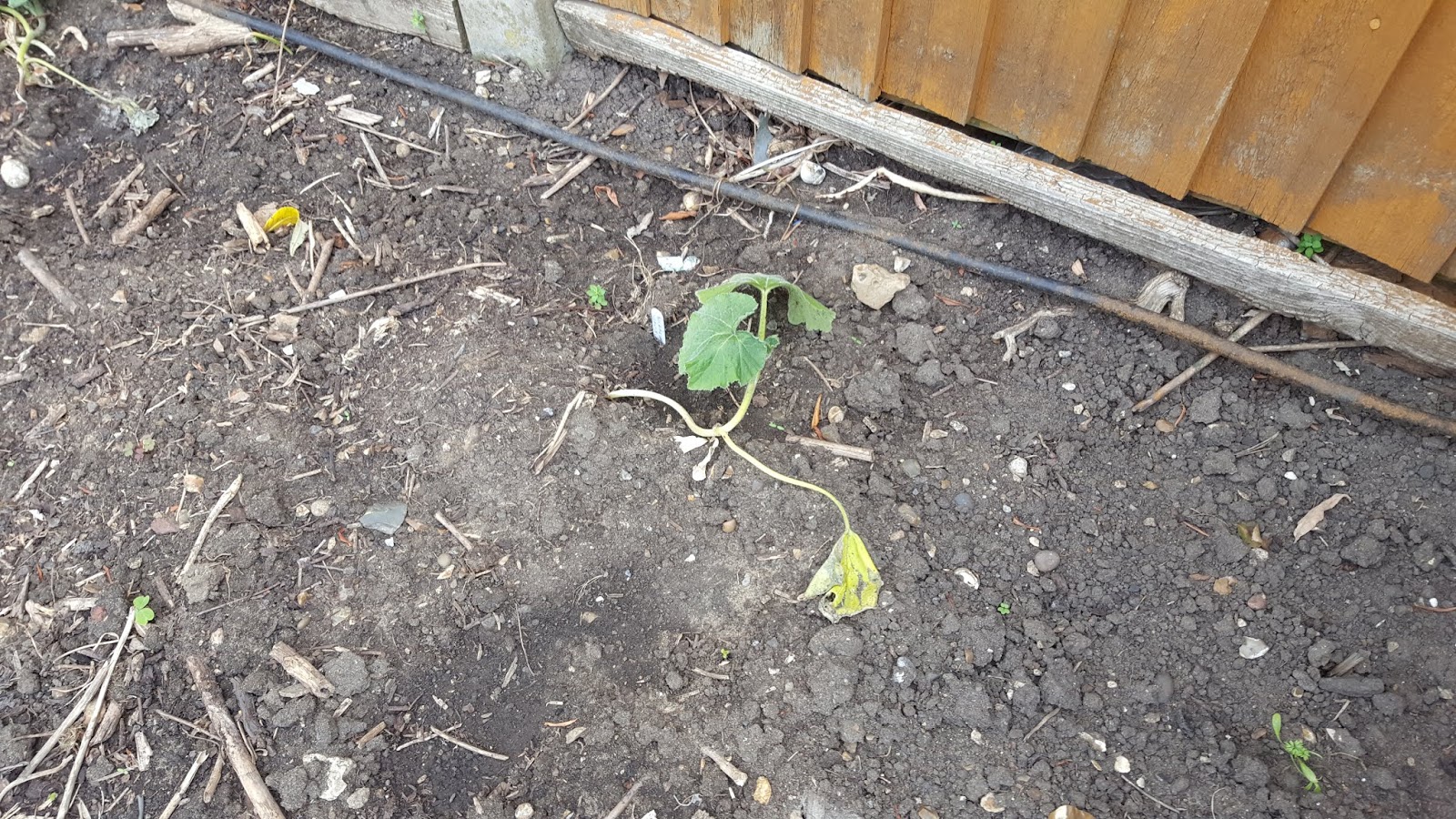
Elsewhere in the garden I have been devastated once again by my own incompetence with cucurbits (in this case squash and courgettes). It was all going so swimmingly. I waited till April to start them indoors in pots so they didn't get too big and delicate before I planted them out, as I have a tendency to damage the stems when that happens. They were growing great guns. Then, I took them outside to harden off. I made the mistake of putting them in far too sunny a spot and far too close together. Instantly leaves started withering from all the sunshine and its rapid drying effect on the soil in their pots. Then, when I came to plant them out, I discovered I had put them far too close together and their leaves and stems had become tangled. Lifting them up broke several of the stems, so when I put them in the ground, most of them upped and died on me. This scraggy looking specimen is one of the hardier and larger survivors. So here I am, back at square one, just like last year when slugs ate all the squashes I planted out.
So, as I was out of courgette seeds due to the infestation of my cucurbit seed envelopes, I nipped down to the local garden centre and bought some new yellow courgette seeds (in line with my unusual colours policy for this year). I then planted these and some winter squash sweet dumpling seeds both straight in the ground and in pots indoors. Indoors worked a lot faster, although I know from some of my current weeds in last year's cucurbit patch that some cucurbits are capable of growing from seed outdoors in my garden.
It's funny to think that within a couple of months this plant will be big enough to give me courgettes, but past experience suggests it will.
I also learned a lesson about the power of being indoors on a sunny table versus being in the greenhouse. The greenhouse gets a lot more sunshine, but indoors has a more consistently high temperature. I wanted to see which one promoted more growth, so I took several of my tomato and pepper seedlings out to the greenhouse a few weeks ago and left the rest indoors. The indoor plants are now giants compared to the greenhouse ones.

In each case the plant that grew in the greenhouse is on the left, the one that grew indoors on the right. They almost don't look like they're the same species, the difference is so big.
However, if you don't have a sunny place indoors to grow plants, the greenhouse is probably a better bet for them than a warm, unsunny indoor room. The year my dining room table wasn't available for plants, most of my seedlings barely grew or died because of the lack of sun in the room I kept them in.
Let's finish this post with a couple of pictures of the shade garden and the apple tree. Both look like they're doing rather well this year. I'm particularly impressed with my hart's tongue fern. It's grown the best of all my ferns and has the most interesting leaves in the shade garden.


Monday, 13 May 2019

How asparagus grows

I currently have one stem of asparagus planted in the garden. I grew it from bare roots, which isn't my favourite way of growing plants as I have such a high failure rate with the bare-root ones. But in this case, I never seemed to manage to get to the garden centre at the right time to buy asparagus in pots and one of the two roots I bought took and I now have a thin single stem of asparagus. This year is its second year in my garden. Here it is on 13 April, a tiny very scrawny stem. It's recognisably asparagus, but way too thin to be worth eating - and harvesting it would probably have killed the plant.
Here it is on 21 April, just 8 days later. It's not got any fatter, but it's got a lot taller and developed side shoots and the beginning of leaves:
And here it is on 12 May. It now has loads of fluffy leaves, but it's now so heavy that it's too skinny to hold itself up and I had to help it with a cane. When it's been in the garden for a few more years, it should have nice thick, sturdy stems and shouldn't need the cane any more.
Edited: excitingly, on 25 May I noticed my asparagus had grown a second, ever so slightly less spindly stem:
Back on 13 May, in other news, all my onions are growing fast and strong and my beans are now all planted:
I've had a bit of trouble with black fly on my broad beans, but it's still at an early stage and I've given them a good spray with water mixed with a few drops of washing-up liquid. The trick to spraying plants for aphids with water and washing-up liquid appears to be to do it when they're in the shade. This seems to avoid damaging the plants.
I hope I've planted enough beans to get a good harvest this year. They definitely seem happy in the partial shade side of the garden, it's a shame crop rotation means I can't just keep them there.
The strawberries are also doing well. My other half kindly fixed the sagging bottom of their container and they are now happy as Larry back in their wooden planter. I've used shredded paper as mulch because it's much cheaper than straw. In fact, companies keep sending me ever greater piles of paper to shred for the garden and what I don't need for mulch goes on the compost heap. The red thing you can see that looks like a strawberry  is actually a painted stone, designed to persuade the birds that these plants produce inedible strawberries. I can't say for certain that it's worked, but I haven't suffered any damage I believe to be caused by birds yet.
I've also taken all my seedlings other than the tomatoes and peppers outside to start hardening them off. Unless there's unexpected bad weather in the meantime, they'll mainly be going out into their final positions in the garden next weekend.
I'm pretty pleased with how the pond area is looking too. It was meant to be a fernery down there, but the ferns are taking their time growing, whereas foxgloves have self-seeded everywhere and I love the look, so I'm now thinking it should be more of a shade garden than a fernery. I'm considering moving my astilbe from the front garden back there as well, or maybe dividing it. I got it for 50p from the manky plants section of B&Q where they sell off all the plants they haven't looked after properly at a discount. I was swayed by the 50p price tag more than having a definite place to put it in mind, and it's very much a shade-loving plant. I think I may also need to look for some more shade-loving wildflowers to fill in the gaps and feed the bees.
I've also cleared most of the duckweed out of the pond with a sieve. Getting all of the duckweed appears to be an impossible task, as no matter how hard I try more always seems to appear, but in a pond this size it's easy enough to keep down to a low level with a sieve. You may also notice that all but one of my pond plants has died - or all but two if you count the duckweed. I'm not sure what happened there, but I have no plans to buy more in the near future.
So, the garden is almost ready for summer, the hard work I've put in planting things is barely visible right now, but it should be an completely different story in a month of two.