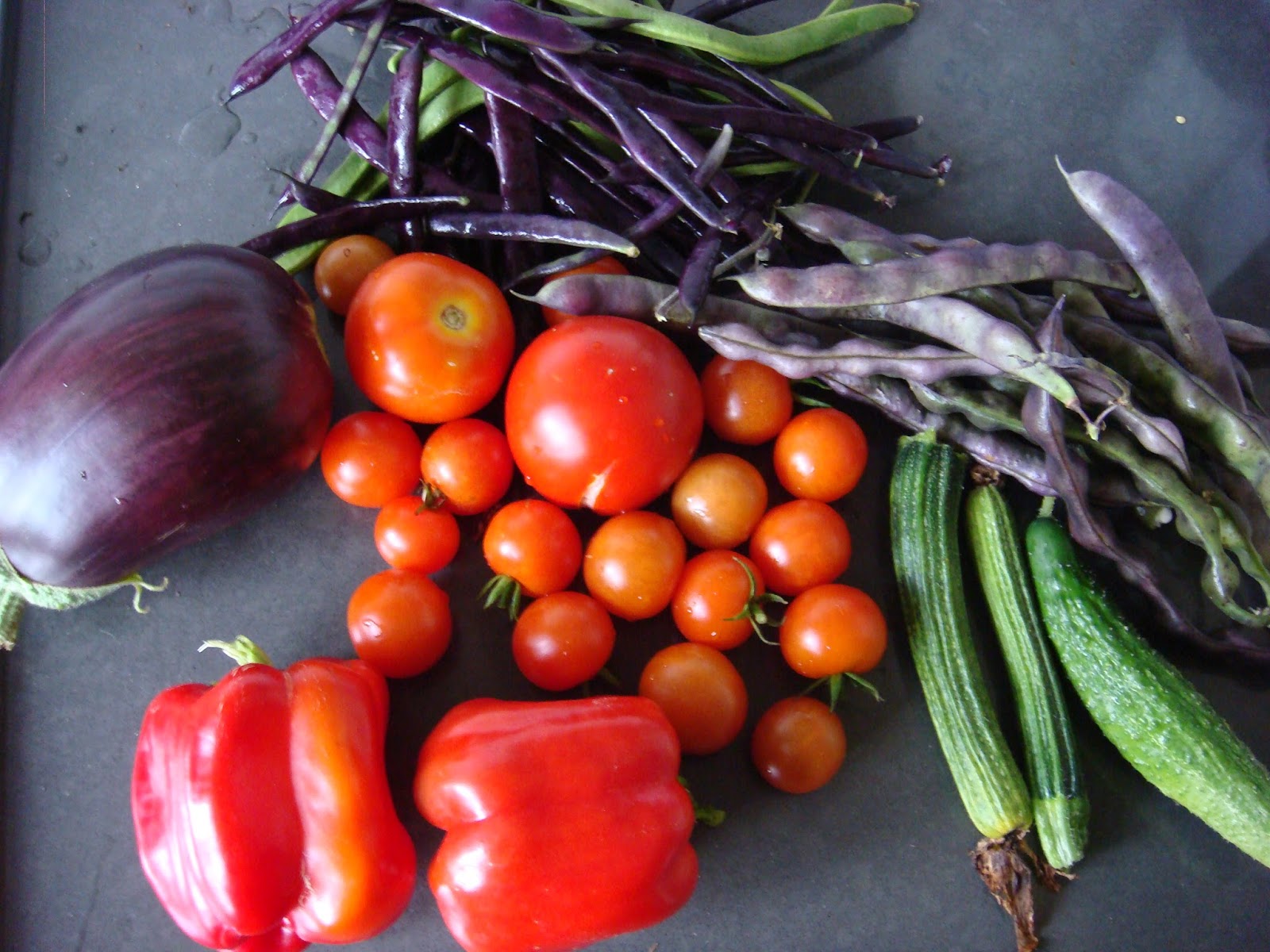
Sunday, 17 September 2017

Rhubarb and raspberry cobbler recipe (sugar-free option possible with stevia)

My neighbour gave me some rhubarb he'd grown in his garden, so I decided to combine it with my raspberries and make a cobbler. I was just about to go on holiday when he brought the rhubarb round, so I decided to freeze it and I also froze the raspberries. So my version of the recipe used frozen fruit, but you could also use fresh fruit, it would just take a bit less time to cook down than mine did.

I decided to use stevia granules instead of sugar because I try to avoid refined sugar. It worked fine in terms of how it baked and the texture, but it definitely didn't taste the same as sugar. I think sugar would have been nicer. We both noticed that it seemed to taste better and less different the next day. I can't say whether that's because we were more used to it, because I served it cold or because stevia's taste changes over time when combined with fruit. One possible option I might try in future is to make the fruit part the say before, then bake it and the cobbler dough the next day.

I've noticed that different stevia granule types differ in how much stevia they say is equivalent to a teaspoon of sugar. The one I used said that a third of a teaspoon of the stevia granules was equivalent to a teaspoon of sugar, so I divided the quantity of sugar I would have put in by 3. Check how much yours says is equivalent to sugar and divide the amount of sugar I've written in the recipe and adjust the quantity accordingly.

You can also use a completely different fruit. This is lovely with cherry pie filling.
Recipe serves 8 (it works fine if you halve the quantities to serve 4)

420 g rhubarb
200 g raspberries
1 rounded tbsp cornflower
120 g sugar (or equivalent quantity of stevia granules)
300 g self-raising flour (or 285 g of plain flour and 4 level tsp baking powder)
pinch of salt
110 g cold butter
75 g sugar (or equivalent quantity of stevia granules)
2 medium eggs
2-4 tsp milk
optionally: 4 tbsp brown sugar (do not substitute in the stevia version, just leave this out)
1 tsp cinnamon

1. Chop the sticks of rhubarb into 3 cm long sections and heat gently in a pan until it looks like this:
2. Add the cornflower and 120 g of sugar and stir thoroughly.
3. Add the raspberries and stir. Turn off the heat.
4.  Preheat the oven to 190° (non-fan-assisted)
5. Sift the self-raising flour (or plain flour and baking powder) and salt into a large bowl.
6. Rub the butter into the flour until the mixture resembled fine crumbs.
7. Stir in the 75 g of sugar.
8. Make a well in the centre of the flour/butter crumbs and crack in the eggs and add 2 tsp of milk. Stir in with a fork, making sure you have thoroughly broken up the egg yolks. Afterwards the dough should look like this:
9. Use your hands to knead it into a smooth ball. You may need to add some of the remaining two tsp of milk to do this. Do this a tiny amount at a time. It goes from too dry to too sticky unbelievably quickly.
10.  Transfer to a floured surface and sprinkle flour on the top as well so the rolling pin won't stick to it (if you don't have a rolling pin you can use a wine bottle or similar cylindrical glass bottle).
11. Roll out to around 3 mm thick, then cut it up into long strips about 6 cm wide.
12. Sprinkle the cinnamon over the strips and spread evenly. Also sprinkle over and evenly spread the brown sugar, if using.
13. Roll each long side of the strip to make very long, thin Swiss rolls, then cut the Swiss rolls into 1.5 cm segments.
14. Divide the fruit filling mixture between ramekins (or put it into whatever oven-proof dish you want to put it in - I did 4 ramekins and a small Pyrex dish).
15. Arrange the chunks of dough on the top with the cut side facing up.
16. You can arrange the ramekins/dish on a baking tray for convenience or just put them straight in the oven.
17. Bake for 15-25 minutes in the oven. If you bake the whole 8 servings in a single dish, it may take a bit longer. Take out when the dough is lightly browned like this:
18. Allow to cool far enough not to burn your mouth, then serve. For the ramekins, I recommend making a hole in the centre with a teaspoon and then (repeatedly) adding single cream. They're also good with custard or natural Greek yogurt. They're also good cold the next day.

Wednesday, 13 September 2017

Green bean and red tomato soup

Yet again I've nicked someone else's recipe idea, made it wrong (and into a vegan recipe) and liked the result so much I've decided to publish it on my blog. This time, in a major break with my usual M.O., it's a soup that doesn't need liquidising! Anyhow, it was rather lovely, but took me ages to make because gathering vegetables from the garden is so time consuming, especially if you're being good about digging carrots up with a fork instead of just yanking and hoping, and also composting your leaves, ends and peelings. So here we go:
Green bean and red tomato soup

(Serves about 5 or 6 in the large, lunch-sized portion sizes I use and gives you over 200g = over 2.5 of your 5 a day)

3 tbsp olive oil (I recommend one with a strong olive flavour)
1 large onion, peeled and finely chopped (frozen is fine, about 200 g)
3 cloves of garlic, finely chopped or crushed (or one block of frozen garlic)
3 large carrots, peeled and finely chopped (around 250 g)
Optionally: some shucked runner beans - I reckon I added about 15
500 ml boiling water
1 vegetable stock cube (alternatively: 500 ml of stock)
350 g fresh green beans, cut into 1-inch pieces (I used runner beans and purple beans)
450 g tomatoes, diced
1 tbsp basil, chopped (frozen is fine)
1 tbsp parsley, chopped (frozen is fine)
salt and pepper to taste

1. Add the olive oil to a large pan and heat on a low heat.
2. Peel and finely chop the onion and add to the pan, stirring occasionally.
3. Peel and finely chop the garlic and add to the pan, stirring occasionally.
4. Peel and finely chop the carrots and add to the pan, stirring occasionally.
5. Shuck any runner beans you want to add the shucked beans to the soup and add to the pan. (Some beans are too old, large and stringy to eat as green beans. You can shuck these = remove their shells/pods. But I find it often takes me a long time because they're hard to get out.)
6. Top and tail your beans and cut them into approx 2-3 cm lengths and add to the pan.
6. Boil 500 ml of water and add it to the pan.
7. Add the stock cube and stir (ideally until dissolved).
8. Simmer with the lid on for 15 minutes. While you are doing this, move on to the next step.
9. Dice the tomatoes and chop the basil and parsley. Once the 15 minutes of simmering from the previous step is up, add these to the pan. Simmer for a further 3-5 minutes.

10. Add salt and pepper to taste. Stir.

That's it, you're done. This soup doesn't need liquidising! Enjoy with bread, rolls or anything else you like to eat with soup.

Saturday, 9 September 2017

Autumn comes to the garden

In an ideal world, this would be a time of mellow fruitfulness. In my garden it's a time of powdery mildew.

Still, it hasn't harmed my squashes or courgettes.


My second-largest courgette was over 20 inches long and weighed more than my kitchen scales could handle. So I had to cut it in half to weigh it (I was about to chop it up for soup anyway). It turned out to weigh a total of 3.154 kg.


The green manure I put in the garden (plants you plant after crops have finished and before the next ones with the idea of improving the soil by digging them in before you plant your next crop) is coming up nicely and should provide more interest than I usually have in autumn and winter. I've planted it in the new bed that the sweet corn was previously in (the bed right at the front of the next photo) and also where there broad beans were, between the yellow flowering rocket and the runner beans.
I've also planted it around the pond in between the foxgloves and the honesty, where it's providing pretty feathery leaves and making me think I must buy some ferns for that end of the garden. The pond is weirdly unphotogenic. Every time I look at it, I think "wow, that's looking really good, I 'm so glad we put in a pond", but every time I try to display its full glory on a photo, it never looks as good as it does in real life. 
The pond has also been growing a new surface plant, which I believe to be duckweed. I'm in two minds about whether to try to remove it. It's supposed to be bad because it quickly covers the surface and starves the pond of light (but then, wasn't that what I was trying to do with the black dye?), and forums say different things about whether wildlife finds it beneficial or detrimental. Given that my pond's so small, I can always fish it out later if I change my mind (probably repeatedly, it sounds like it has that sort of persistence), but for now I'm going to hang onto it and see if more wildlife appears and if the other plants survive it.

Monday, 28 August 2017

Garden curry (vegan/vegetarian recipe)

I saw a curry on Gardener's World and liked the look of it a lot, but I couldn't find the recipe, so I ended up making up my own. I based it largely on what I had in the garden and in the fridge and also on this recipe from Tesco.
Anyhow, it turned out to be incredibly delicious and I am under instructions from my other half to make it again exactly like I made it the first time. My theory is that you can be pretty flexible about most of the veg in it, but the pineapple is essential and probably also the okra and aubergine. Anyhow, here's the original recipe:

Garden curry recipe (mild)
Serves 6

2 heaped tbsp coconut oil
1 large onion (=200g), peeled and diced (frozen is fine)
1 block of frozen garlic (=approx. 4 cloves of garlic, crushed)
1 block of frozen ginger (=approx 3 cm of a ginger root, crushed)
1 aubergine (approx. 300 g), cut into chunks
200 g okra, cut into chunks
1 red pepper, chopped
1-2 courgettes (approx. 50-100 g), chopped
60 g cucumber, peeled and chopped (optional)
50 g podded beans from runner or French beans (optional)
1 tsp ground fenugreek
1 tsp cumin
1 pinch chili flakes (feel free to add a load more chili if you love your curries hot)
1/2 tsp turmeric
500 g tomatoes, chopped (ideally skinned)
1 fresh pineapple, peeled and chopped
500 ml boiling water
1 tbsp tomato puree
4 tsp tamarind sauce (optional)
200 g runner beans/French beans, chopped
4 tbsp natural yogurt (optional - leave out for vegan version)

1. Heat the oil in a very large pan (I used a Le Creuset casserole dish).
2. Add the onion and cook for 10 minutes, until softened, stirring occasionally. While it is cooking, (peel and) chop more of the vegetables for the recipe (in the order they appear in the list of ingredients - you can see what size to chop them from the pictures below - the rough rule of thumb is bite size).
3. Add the garlic and ginger to the onions. Keep chopping vegetables until the garlic and ginger have defrosted and can be stirred into the onions (about 5 minutes).
4. Add the aubergine and stir occasionally for 5 minutes. During that 5 minutes, keep chopping vegetables!
5. Add the okra, red pepper, courgette, cucumber and any podded beans (I only ended up with a few, they took forever to shell).


6. Stir in the ground fenugreek, cumin, chili flakes and turmeric.
7. Add the tomatoes and the pineapple.
8. Add 500 ml of boiling water, the tomato puree and (optionally) the tamarind. Bring to the boil, then reduce the heat and simmer for 20 minutes. While it's simmering, chop the runner/French beans if you haven't already done so.
9. Add the runner/French beans and simmer for another 4-5 minutes.
10. Optionally serve with yogurt on top. Serve with rice or naan or chapati or anything else you usually serve with curry. I served mine with some paratha that I found in the freezer section at Morrison's and they were gorgeous.
This is what it looks like if you don't add the tamarind

Thursday, 24 August 2017

Curried cottage pie recipe

This is one of our favourite recipes. I haven't included it before because I haven't often included vegetables from the garden in it. This time, because our local supermarkets no longer sell pre-chopped celery, carrot and onion, I had to chop my own and included some carrots from the garden in it.
What happens when you grow your carrots in stony ground
I also managed to include one of the milder chilis we grew.
Anyhow, here's the recipe with options for swapping things out, in case you can't get pre-processed ingredients or can and want to save time.

Curried cottage pie
Serves 6 when I serve it, could potentially serve 8 smaller appetites
Takes about 90 minutes - 2 hours

2 tbsp olive oil
750 g of minced beef (I used frozen)
120 g celery, finely chopped
120 g carrots, peeled and finely chopped
120 g onion, finely chopped (you can use a frozen/pre-chopped mix of these 3 veg, I recommend 350 g of it)
1 small chilli, with a hotness of your choice, finely chopped (or 1/2 tsp mild or strong chilli powder, according to taste)
2 tsp ground coriander
1 tsp ground cumin
3 tsp (mild) curry powder
1 tbsp tomato puree
1 beef stock cube
200 g passata (I freeze any leftovers in an ice cube tray)
2 tbsp Worcester sauce
optionally: 150 g of runner beans, green beans or other beans, topped and tailed and chopped
1.2 kg potatoes
700 g frozen carrot and swede mash, frozen (or 340 g carrot, 340 g swede, 20 g butter)
50 g butter
2 tsp nutmeg
salt and pepper to taste.

You will need: a large pan (e.g. a casserole pot), a large oven proof dish and a potato masher.

1. Heat the olive oil in a very large pan, e.g. a casserole pot. Brown the mince. While it is browning stir occasionally and get on with the next step.
2. Finely chop the celery and peel and finely chop the 120 g of carrots and the onion. (Tip: if you have to buy more celery than you need, you can finely chop it and freeze it in bags of the right weight for next time.)

3. Once the mince is browned, set it aside (I put it in the oven-proof dish I'm going to make the curried cottage pie in).
4. Add the chopped onion, celery to the large pan and stir for a few minutes. While stirring, get on with the next step.
5. Finely chop the chili - if you can't take much chili heat like me, make sure you remove all the seeds - and add to the large pan. Feel free to use more and/or hotter chili than my recommendation if you prefer something hotter.
6. Add the coriander, cumin and curry powder and stir for one minute.
7. Add the tomato puree, stock cube, passata and Worcester sauce plus 400 ml (3/4 pint) of boiling water.
8. Return the mince to the pan and simmer for about 35 minutes. Meanwhile continue with the next step.

9. Peel the potatoes and cut into even chunks. If you are using fresh carrot and swede instead of the pre-made mash, also peel these and cut them into chunks. Boil the potatoes (and the 350 g each of carrot and swede if using fresh) for about 20 minutes until soft. While these are cooking, get on with the next step.
10. If using pre-made frozen carrot and swede mash, microwave/pan heat it as per the instructions.
11. Pre-heat your oven to 200° fan/220° non-fan.
12. If using beans, top and tail them and chop to 2-3 cm lengths.
13. Mash the potatoes (and fresh carrot and swede if using fresh), mix in the butter (70 g if using fresh carrot and swede, otherwise 50 g), nutmeg, salt and pepper to taste, and carrot and swede mash.
13. Season the mince mixture to taste with salt and pepper. If using beans, add the beans to it and stir, then spoon the mince mixture into the large ovenproof dish.
14. Spoon the mash over the mince mixture and spread to cover evenly.

15. Cook in oven for 25-30 minutes.


Saturday, 19 August 2017

Courgette, herb and Parmesan soup

This courgette soup is delicious and the perfect way to use up a glut of courgettes - including huge ones. I used a single 2 kg courgette to make the soup.
Not the courgette I used in the soup, I reckon this one is 3 kg or more
Courgette, herb and Parmesan soup recipe

NB This soup needs liquidising.

2-3 tbsp olive oil
3 tsp/3 cloves garlic, chopped (frozen is fine)
1 tbsp basil leaves, chopped (frozen is fine)
salt, to taste
pepper, ground, to taste
2 kg courgettes, unpeeled, chopped into chunks of about 2 cm
1 chicken or vegetable stock cube/stock pot/1 tsp vegetable bouillon powder
1 tbsp parsley, chopped (frozen is fine)
50 g/4 tbsp finely grated Parmesan (optionally plus extra to serve)

1. Chop up the courgettes into chunks of about 2 cm across. Leave the skin on. Don't bother removing the seeds.
2. Heat the oil in a large pan over a medium heat.
3. Add the garlic and heat for 2-3 minutes, stirring regularly.
4. Chop the basil and add to the pan.
5. Add the courgette and some salt and pepper (about a 1/2 tsp of each). Stir, put the lid on the pan if it has one, and simmer on a low heat for 10 minutes. A lot of liquid will come out of the courgettes.
6. Add the stock cube and stir (ideally until it has dissolved).
7. Simmer for 8 more minutes, uncovered.
8. Chop and add the parsley. Grate and add the Parmesan. Stir.
9. Remove from the heat.
10. In as many batches as necessary, liquidise the soup in a liquidiser or food processor until smooth.
11. Return to the pan (or the tub you're going to store it in).
12. Serve with bread and optionally with extra Parmesan sprinkled on top of the soup.